Work plan summary
The project aims to validate and substantiate the anecdotal evidence that L-serine improves seizure control, cognitive function, motor skills, sleep and behaviour in patients with GRIN-NDD. By conducting a series of single patient (N-of-1) trials, along with pre-clinical and clinical biomarker studies, the project seeks to determine the efficacy, safety, and tolerability of L-serine in children and young adults with GRIN-NDD characterized by seizures, intellectual disability, and behavioural disorders.
This precision medicine strategy aims to identify responders and tailor treatment on a case-by-case basis. The project integrates innovative companion biomarkers, including neurophysiological measures, and cellular models to monitor treatment response. By using variant-specific 2D and 3D cell models derived from patient iPSCs, the study will assess the functional and molecular impact of L-serine, providing insights into its therapeutic mechanisms.
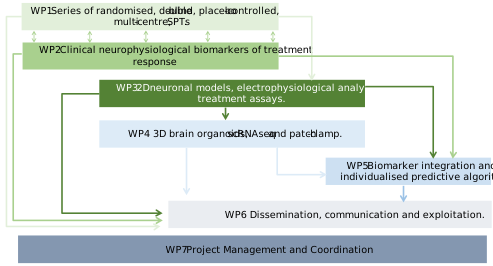
The work plan consists of 7 work packages (WPs):
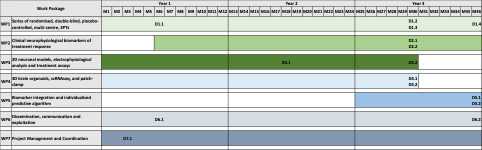
WP1: Conduct randomized, double-blind, placebo-controlled, multi-center N-of-1 trials to evaluate L-serine's effects on behavior, cognition, and seizures. Patients will undergo multiple treatment cycles, with efficacy assessed through behavioral checklists, cognitive tests, and seizure diaries.
WP2: Utilize EEG and TMS to identify neurophysiological biomarkers of treatment response. Resting EEGs and paired-pulse TMS will measure cortical excitability and connectivity.
WP3: Develop 2D neuronal models from patient-derived iPSCs to study L-serine's effects on neuronal activity and plasticity using electrophysiological and molecular assays.
WP4: Generate 3D brain organoids from patient iPSCs to investigate L-serine’s impact on neuronal development and synaptic plasticity through single-cell RNA sequencing and patch-clamp techniques.
WP5: Integrate all clinical, neuropsychological, and preclinical biomarker data to develop a predictive algorithm for individualized treatment response and optimal drug combinations.
WP6: Disseminate findings to patients, families, and the scientific community, incorporating patient perspectives through collaboration with patient advocacy organizations. The partners will release at month 4 a plan for the communication and dissemination of the project results.
WP7: Project coordination and management will be carried out for the entire duration of the project. A Data Management Plan (DMP) will be developed within the first 3 months.
The project is novel and original in its application of a comprehensive, translational approach combining N-of-1 trials with advanced clinical, electrophysiological and cellular model studies. The integration of multi-modal biomarkers, genetic stratification, and individualized treatment strategies highlights its innovative potential. The feasibility is supported by the established patient cohorts, collaborations with specialized centres, and the robust methodological framework ensuring reliable and actionable results.